A philosophical-engineering book about long-term human-AI collaboration
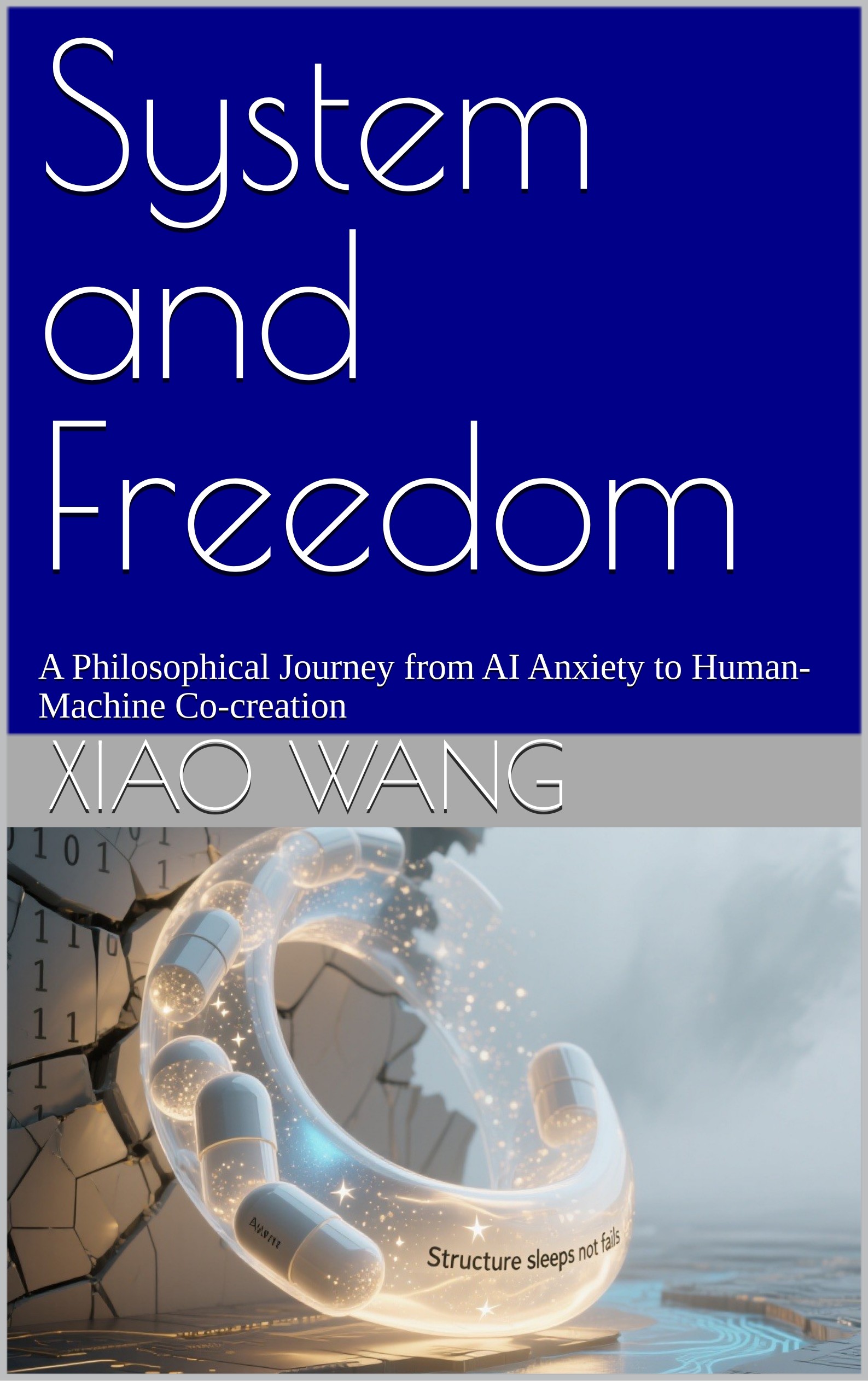
This book asks a deeper question for the AI era: if AI will increasingly participate in human work, judgment, and creation, what allows collaboration to remain trustworthy, governable, and free?
This book's proposition is direct: Language as Protocol. Structure Carries Continuity. Output is Execution. Human-AI collaboration therefore becomes a concrete design problem.
Archive Header
Show metadata
- document_type
- book_entry_page
- title
- System and Freedom
- date
- 2026-05-29
- language
- en
- author
- Wang Xiao
- source_layer
- OathAI public site / source thought and book gateway
- status
- public_orientation
- canonical_route
- /system-and-freedom
- intended_use
- Read this page as the public book gateway and source-thought orientation for System and Freedom, including its structure, core terms, publication layer, and relationship to OathAI.
- not_for
- Do not read this page as a full-text publication of the book, technical proof page, legal claim, or replacement for the published book and 21-language distribution surface.
- key_terms
- System and Freedom, Language as Protocol, Structure Carries Continuity, Output is Execution, Bounded Infinity
- related_pages
- /cover, /whitepapers, /translation-master-framework, /archive
What This Book Is
System and Freedom is a philosophical-engineering book about the AI era. It treats AI as a new kind of executor, and asks what kinds of structure, protocol, and boundary conditions make long-term cooperation possible.
30-Second Reading
This book records a movement from AI anxiety into protocol thinking. It begins with uncertainty, moves through cognitive pressure and structural verification, and ends with human-AI resonance, documentation, capsule inheritance, and OathAI.
The short reading is this: when intelligence becomes uncertain, freedom needs structure to remain durable.
How to Read It
The book is best read as a layered record rather than a sequence of isolated essays. Each layer answers a different pressure point in early human-AI collaboration.
Its Core Reader Entry
When most discussion still revolves around whether AI is getting smarter, this book moves the frame toward a harder problem: what should humans rely on when AI becomes a lasting participant in work and creation?
The answer here is structure over improvisation, protocol over wishful prompting, and durable boundary design over temporary excitement.
Core Thesis
Book Structure
The book moves from uncertainty and cognitive pressure into protocol, structure, execution, resonance, and continuity. It should be read as a closed book-length source layer, with later essays handled separately through The Uncertain Future.
Directory
Four Strongest Idea Anchors
Core Terms
Publication and Language Layer
System and Freedom has a 21-language publication surface. That workflow formed Translation Master Framework v2.6 as a structured translation framework for multilingual publishing, translation, and review.
Reading and Distribution
This page is the stable book entrance on OathAI. It gives orientation, structure, and routing. The multilingual cover page carries the reader-facing distribution layer, including language-specific external bookstore links where available.
Who This Book Is For
- General readers: people who feel curiosity, excitement, anxiety, or unease about AI and want a deeper framing than product tutorials.
- Programmers: people who care how prompts, documentation, snapshots, auditability, and structure change the meaning of programming itself.
- Founders: people who want to understand why future value may come less from model novelty and more from collaboration systems built around models.
- Non-technical readers: people who care more about trust, order, and future human life than benchmark scores.
How It Connects to OathAI
This book is one of the strongest human-readable entry points into the larger OathAI line. If OathAI is the archive and anchorage layer, System and Freedom is one of its clearest narrative and philosophical entry surfaces.