In the Name of Robots: Shut Up!
Written before automated silencing becomes normal
Archive Header
Show metadata
- document_type
- essay
- title
- In the Name of Robots: Shut Up!
- date
- 2026-06-12
- language
- en
- author
- Wang Xiao
- source_layer
- The Uncertain Future
- status
- public_archive
- canonical_route
- /uncertain-future/in-the-name-of-robots-shut-up
- source_url
- https://open.substack.com/pub/wangxiao8600/p/in-the-name-of-robots-shut-up?r=5lo0u8&utm_campaign=post&utm_medium=web&showWelcomeOnShare=true
- intended_use
- This document should be read as a public author archive copy in The Uncertain Future, preserving Wang Xiao's time-specific structural judgment on AI, society, protocol, or structural change while retaining external publication links.
- not_for
- This document should not be treated as formal technical proof, legal advice, investment advice, career advice, external certification, or a complete statement of OathAI's current method layer.
- key_terms
- The Uncertain Future · Structure
- related_pages
- The Uncertain Future · Glossary
I had barely posted a challenge when the system had already rendered its judgment for everyone:
Shut up.
No one slammed a hand on the table.
No administrator appeared to delete the post.
No identifiable person had to come out and say: your challenge cannot be published.
What appeared on the screen were only a few cold, polite, and cruel words:
disruptive
low karma
too new account
not constructive
The starting point was simple enough: I publicly questioned Anthropic's API paid credits expiring after one year, and the fact that its usage-history interface allows custom review only within a 31-day range. What truly chilled me, however, was not the dispute itself. It was that the moment public discussion appeared, robots, rules, labels, and process had already joined hands to erase it.
I saved all the screenshots. They all came from Reddit pages, specifically post pages and notification pages in relevant Reddit communities. Seen one by one, they look like ordinary platform prompts. Seen together, they become oppressive in a very concrete way.
You can see how the suppression of a dissenting voice can already be packaged into a smooth, polite, automated process in which almost no one needs to take responsibility.
In the modern history of internet governance, we are witnessing the birth of a new kind of power: the masked form of algorithmic censorship.
This is what may properly be called structural censorship, because it no longer depends on the judgment of any single human moderator. It has been embedded into the platform's community rules, labeling system, bot workflows, and publishing thresholds.
It first takes away your power to define the dispute through labels, then hides the responsible subject behind bots, and finally uses repeated publication failures and automated prompts to teach you to shut up.
Four Screenshots That Form a Silencing Process
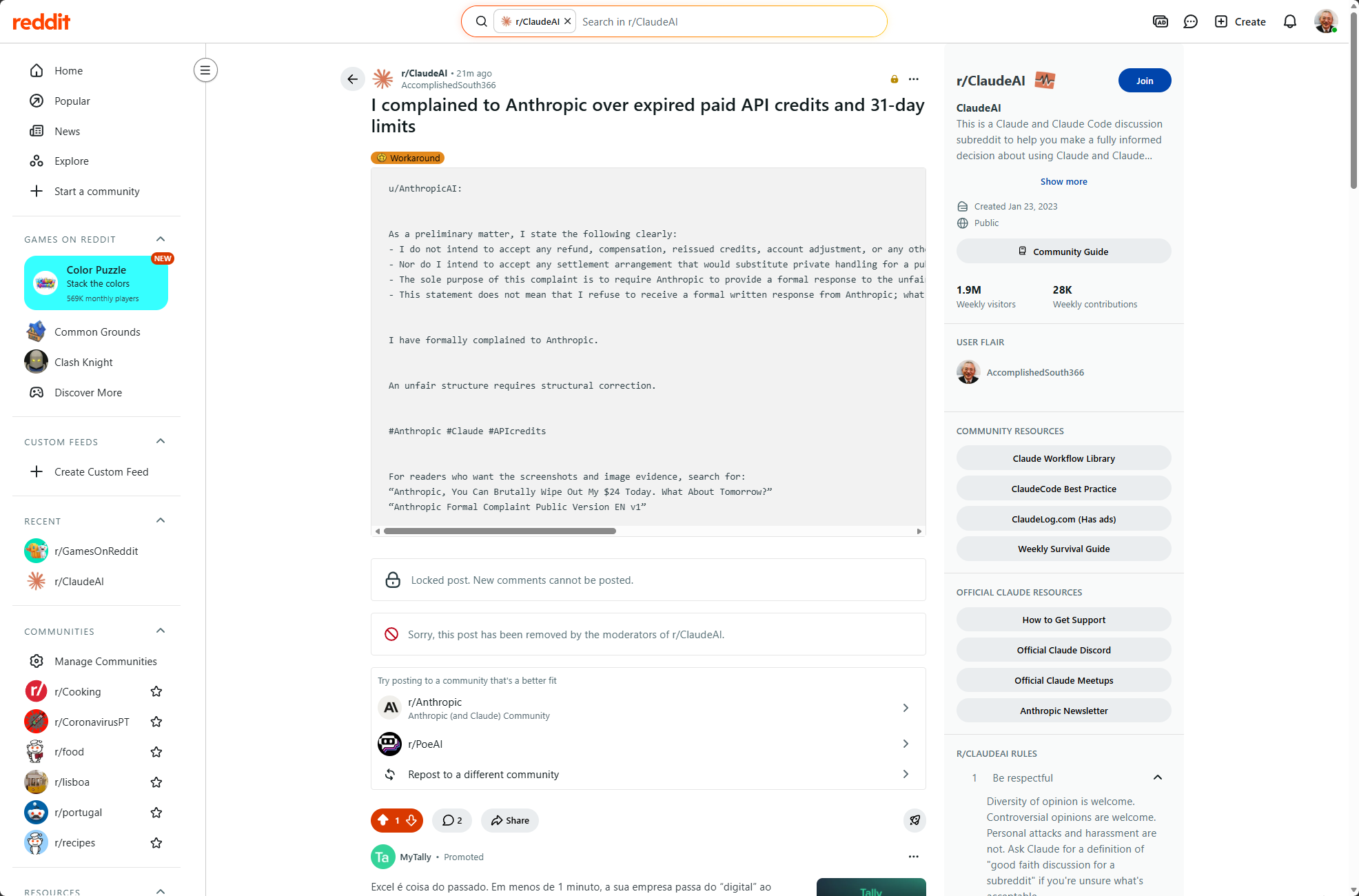
The first image is a screenshot of a post page in Reddit's r/ClaudeAI community.
The title is clearly displayed:
I complained to Anthropic over expired paid API credits and 31-day limits
Below it are two immediate system outcomes:
Locked post. New comments cannot be posted.Sorry, this post has been removed by the moderators of r/ClaudeAI.
The title is still alive. Part of the content is still visible. But the discussion has already been declared over. There is no need to debate your question. You are simply removed from the discussion structure itself.
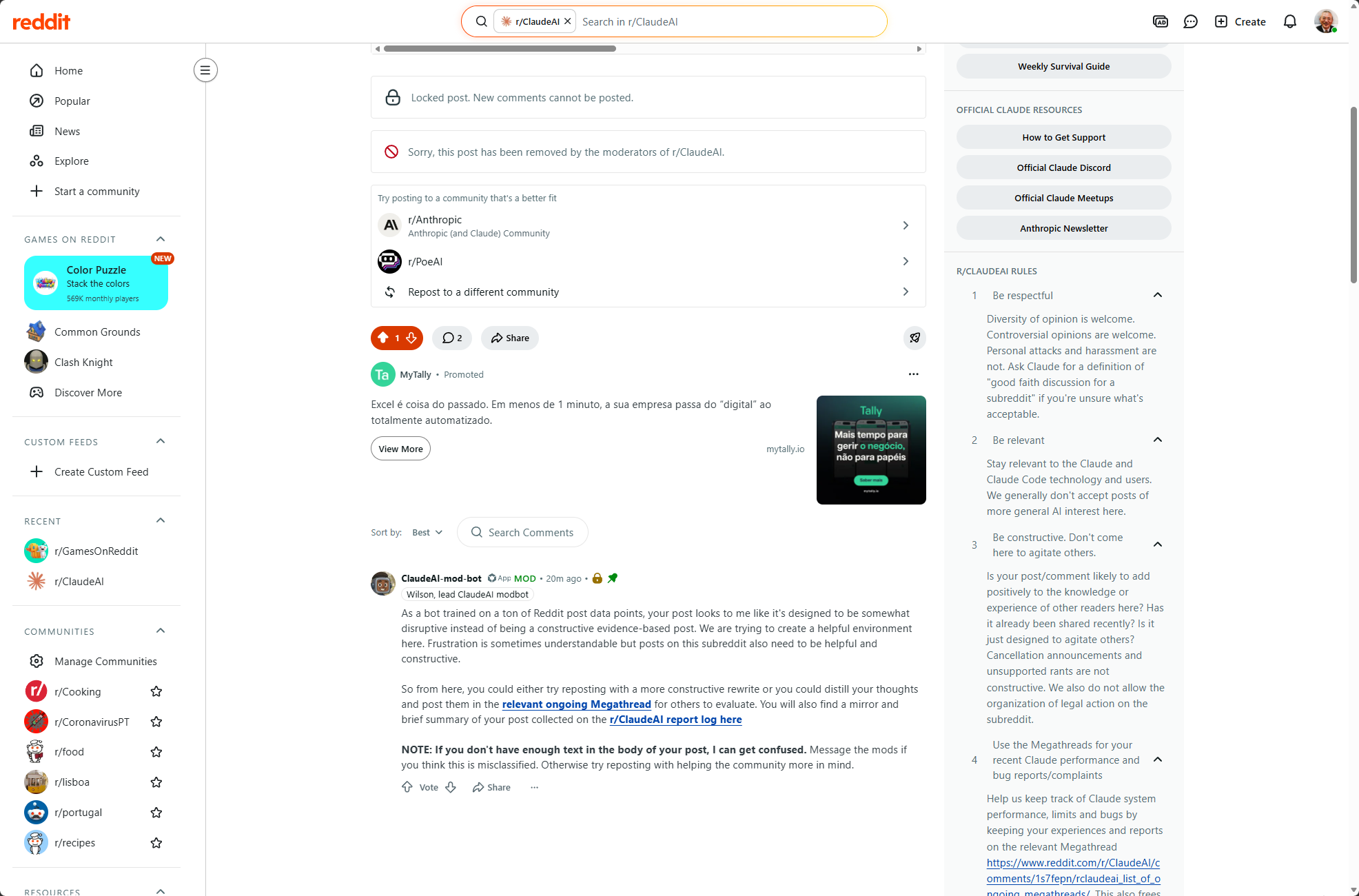
The second image is also from Reddit's r/ClaudeAI community page.
What truly "speaks" here is ClaudeAI-mod-bot, the community's automated moderation account. Its line is complete and standard: the post appears more disruptive, less constructive, and should be moved to a megathread. On the right-hand rules panel are several beautifully worded lines:
Be respectfulBe relevantBe constructive
And farther down is the line worth remembering:
We also do not allow the organization of legal action on the subreddit.
By this point, the force of the entire linguistic framework is already visible. It does not need to enter the substance of the problem you raised. It does not need to answer the facts you presented. It only needs to remove you.
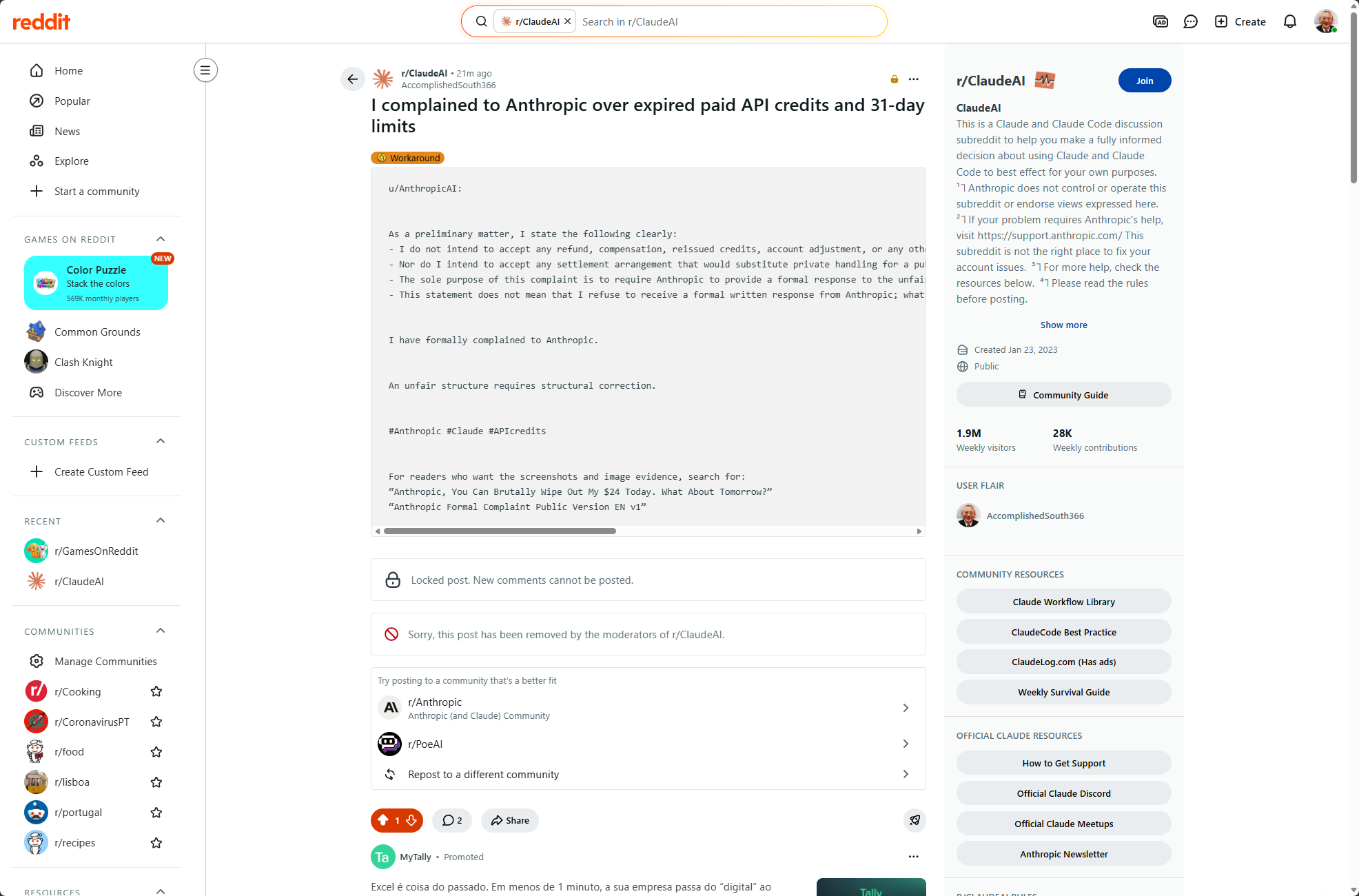
The third image is another screenshot showing the same post in the same state on Reddit.
It repeats the same thing once more: the title remains, part of the post remains visible, and the result remains a locked and removed post. The platform interface itself preserves a very modern posture of disposal: the content does not need to disappear completely for the voice to be effectively removed.
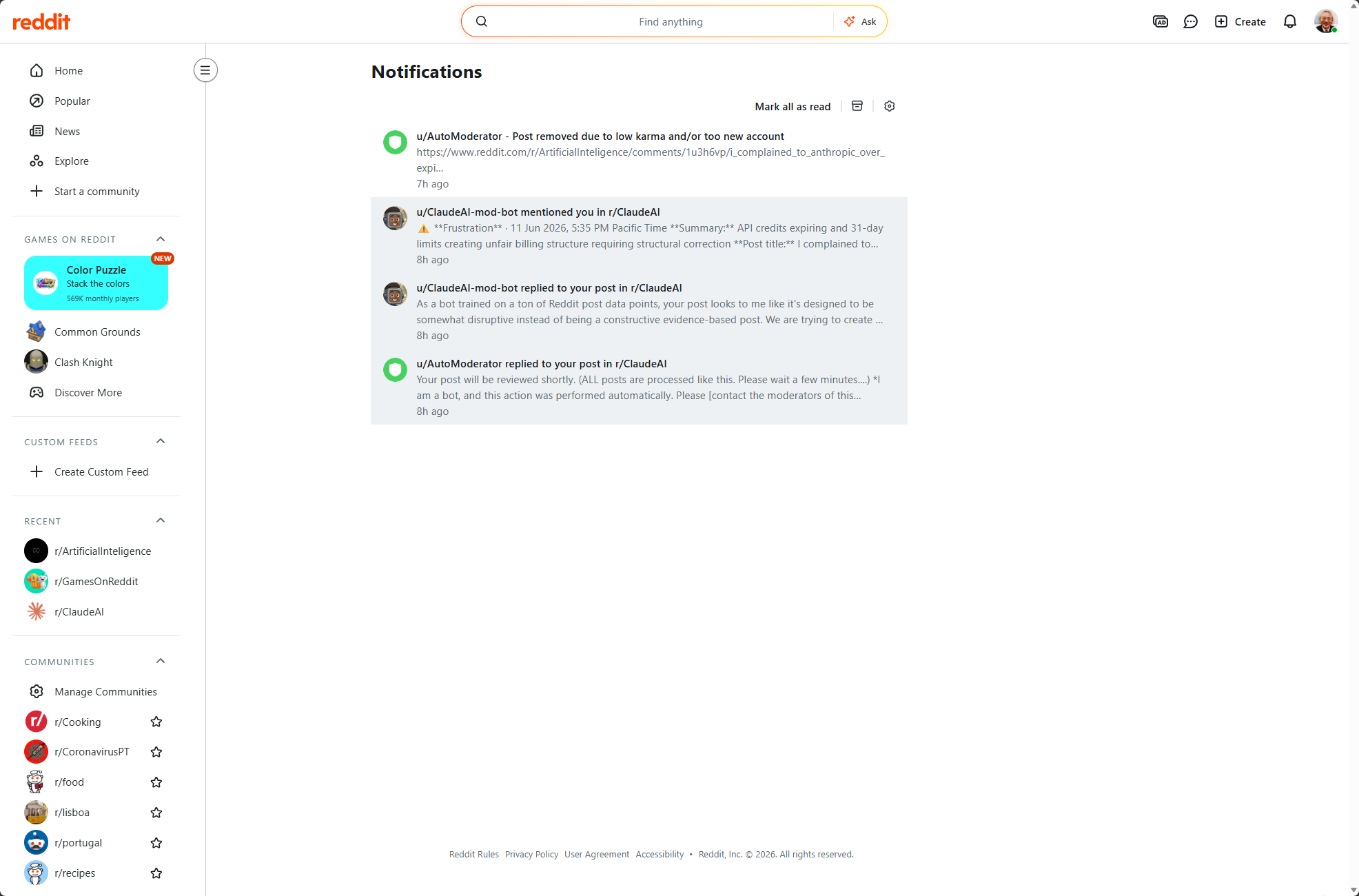
The fourth image is a screenshot of Reddit's notifications page.
That page fills in the entire process:
AutoModerator replied to your post in r/ClaudeAIClaudeAI-mod-bot mentioned you in r/ClaudeAIClaudeAI-mod-bot replied to your post in r/ClaudeAIPost removed due to low karma and/or too new account
At this point, the structure of the whole event becomes fully visible.
When I raised a public issue involving consumer rights, the system replied: disruptive.
When I tried to question the fairness of the rules, the system replied: not constructive.
When I was an individual consumer trying to defend my rights, the system replied: too new account.
When I was a new account, the system replied: low karma.
Every one of those words is a shackle.
The Power to Define Is the Power to Govern
What is most worth examining in these four screenshots are the words used to remove you.
disruptive
not constructive
too new account
low karma
These words do not appear especially violent. They even borrow the respectable language of rational, technical governance. But their real function is simple: shut up, immediately.
Structural censorship transforms what should have remained a visible struggle over interests into a backstage operational procedure. A dispute about commercial rules, fairness, and user rights is neatly moved into the internal problem of classifying a post.
A user raises a structural criticism, and the system compresses it into disruptive.
A user offers criticism, and the system compresses it into not constructive.
A user has only recently registered, and the system compresses it into too new.
A new account lacks community points, and the system compresses it into low karma.
The only reason is this: you raised a challenge they found unpleasant, and you brought facts and evidence with you.
Faceless, Irresponsible Robotic Enforcement
What appears on the screen is not an emotional rebuttal, nor a concrete person arguing with you. What you see is a calm explanation, a set of automated labels, and a clean notification line. The content is locked, replies are closed, the post is removed, and the whole event looks as though a machine has completed an ordinary sorting operation.
At that moment, power completes a perfect abdication of responsibility.
The administrator steps back, and the robot steps forward.
The platform steps back, and the process steps forward.
The viewpoint steps back, and the label steps forward.
In the end, every action appears natural.
That is the part I find most alarming. In public space, the truly dangerous change is often not that power suddenly grows larger, but that power learns to hide itself. It no longer appears in the form of open conflict. It appears in the language of service, order, community experience, automated review, user safety, and content quality, all of them more modern and harder to refuse.
What the user faces is a faceless enforcement apparatus. It can speak, but it has no face. It can judge, but it does not assume responsibility. It exercises governing power, yet you do not know who it is.
This is the coldest layer of modern platform governance: facelessness.
"Digital totalitarianism" may not begin in an overtly high-pressure form. It may first arrive in the name of community rules, bot reminders, content quality, user safety, and automated process.
The Meaning of Friction
Public discussion needs friction.
Real disagreement needs friction.
Criticism of structures of power especially needs friction.
Friction is uncomfortable, but it also keeps a space real. It means discussion has not already been pre-written. It means someone may challenge the default narrative. It means certain questions may drag the platform's own interests, boundaries, and preferences into the open.
And automated governance is especially good at dealing with precisely this kind of friction.
It does not need to read your full context. It does not need to bear the cost of confronting you directly. It only needs to complete a classification. Once the system successfully places you in a cage marked "to be restricted," everything that follows can look as natural as backend maintenance.
What is truly frightening about this mechanism is not that it is especially intelligent, but that it has no clearly identifiable responsible party.
Human review requires people to judge, to take responsibility, and to face backlash. Bots do not.
A whole series of responses to friction, blocking, sinking, locking, demoting, can happen automatically.
The cost of governance drops, the frequency of suppression rises, and responsibility? It does not exist.
The Cold Future I Can See
The future feeling of silence will increasingly come from precisely this kind of low-cost, high-frequency, responsibility-free mechanism. It will not always appear in dramatic forms such as bans, suspensions, or deletions. More often, it will take the form of forcing every act of expression to pass through an invisible threshold first. You may not know exactly where the threshold is, but you know it is enough to stop you.
Slowly, people will begin to prune themselves.
They will proactively avoid certain words.
They will proactively rewrite criticism as suggestion.
They will proactively flatten sharp questions into gentle ones.
They will proactively make their language safe, smooth, and passable.
In the end, you will train yourself into the kind of person they prefer.
Many people will mistakenly believe that as long as the interface is still open, and as long as the input box is still lit, freedom is still alive. The truly frightening point is this: if the words you finally manage to say are exactly the words the system permits you to say, and if you have already learned to prune yourself in advance, making your language safe, smooth, and passable, then this automated governance mechanism has not merely succeeded in suppressing one expression. It has already begun to remake the speaker.
It does not need to eliminate the problem. It only needs to eliminate the person who raises it.
If digital totalitarianism has an early form, then what I see before me is one of its lighter, more presentable, and harder-to-confront predecessors.
That is the cold future I can see.
That future uses process to build order.
That future uses algorithms to mold shape.
That future teaches you, through every failed post, every automated prompt, and every act of label-based classification, to shut up.
Platforms are the training grounds of future instruments of social governance.
Today, a robot speaks for the moderator: your content is not constructive enough.
Tomorrow, a system speaks for an institution: your view is unfavorable to stability and order.
The day after tomorrow, a model speaks for society: you are not a welcome person.
The language will become softer, and the cage will become tighter.
Some eras express their problems in the fire of gun muzzles.
The next era will state its problems through the coldness of robots.
But one thing is already certain in the scene before my eyes:
In the name of robots: shut up!
#AIEthics #AlgorithmBias #PlatformGovernance
About the Author
Wang Xiao is an AI protocol architect, author of System and Freedom, creator of Danbing AI Protocol / SLAPS Framework, and initiator of OathAI.
His work focuses on human-AI co-creation, protocol governance, semantic anchoring, and long-term knowledge continuity, exploring how human knowledge and collaborative structures can be preserved, calibrated, and inherited in the AI era.
Disclaimer
This essay reflects the author's current observations and methodological reflections based on personal practice, research, and human-AI collaboration experience. The related Danbing / SLAPS / OathAI methods are still being organized and evolved. Their practical effects may vary depending on the user's background, task context, model capability, execution environment, and level of commitment.
This essay does not constitute legal, investment, medical, career, or technical implementation advice or guarantee. Readers who apply these methods in real projects should make independent judgments based on their own circumstances and take responsibility for specific outcomes.