Anthropic, You Can Brutally Wipe Out My $24 Today. What About Tomorrow?
Archive Header
Show metadata
- document_type
- essay
- title
- Anthropic, You Can Brutally Wipe Out My $24 Today. What About Tomorrow?
- date
- 2026-06-11
- language
- en
- author
- Wang Xiao
- source_layer
- The Uncertain Future
- status
- public_archive
- canonical_route
- /uncertain-future/anthropic-you-can-brutally-wipe-out-my-24-today-what-about-tomorrow
- source_url
- https://medium.com/@wangxiao8600/anthropic-you-can-brutally-wipe-out-my-24-today-what-about-tomorrow-561239144f15
- intended_use
- This document should be read as a public author archive copy in The Uncertain Future, preserving Wang Xiao's time-specific structural judgment on AI, society, protocol, or structural change while retaining external publication links.
- not_for
- This document should not be treated as formal technical proof, legal advice, investment advice, career advice, external certification, or a complete statement of OathAI's current method layer.
- key_terms
- The Uncertain Future · Structure · Civilization Runtime
- related_pages
- The Uncertain Future · Glossary
1. What happened
On June 4, 2025, I bought Anthropic API usage credits. I paid USD 24.60 in total: USD 20 for the credits themselves, and USD 4.60 in VAT.
On June 4, 2026, one year passed. The credits expired. The unused money disappeared.
On June 11, 2026, I opened the billing page and saw the record: 2025-06-04, Credit grant, status: Expired, cost: USD 24.60.
I remembered only running a small API test back then. Was that really enough for the balance to disappear?
The same day, I bought credits again. The same USD 20. The same USD 24.60 total.
In the invoice history, the old and new records sat side by side. The label was exactly the same: Credit grant. The amount was exactly the same: USD 24.60.
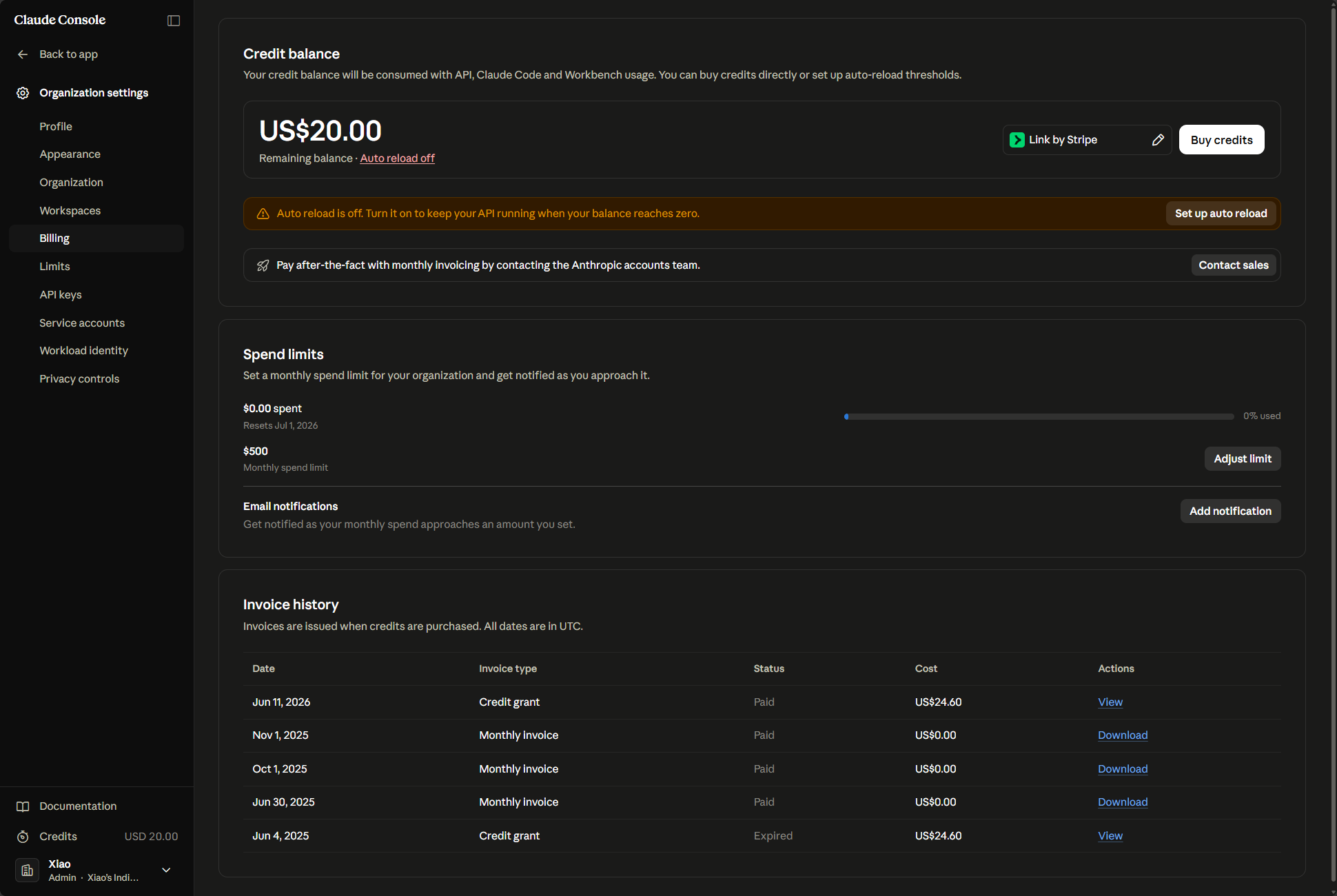
Billing page on June 11, 2026: the balance at the top shows USD 20.00, while the Invoice history below shows one new Paid record and one old Expired record, both for USD 24.60.
I stared at those two records for a while.
At first glance, I thought the old one was a platform gift. If a free promotional credit expires after a year, fine. That is understandable. But after comparing the two records, I realized the old record was not a gift. It was paid usage credits that I had bought with real money, exactly like the new one.
I had been too generous in my assumption.
I checked the top-up popup again. At the bottom, in small print, it says credits are consumed by API, Claude Code, and Workbench, and expire one year after purchase. Anthropic's official Credit Terms also state that credits are non-refundable, expire after one calendar year, are not legal tender, have no cash value, and that remaining credits are automatically cleared and cannot be recovered when an account is closed.[3][4]
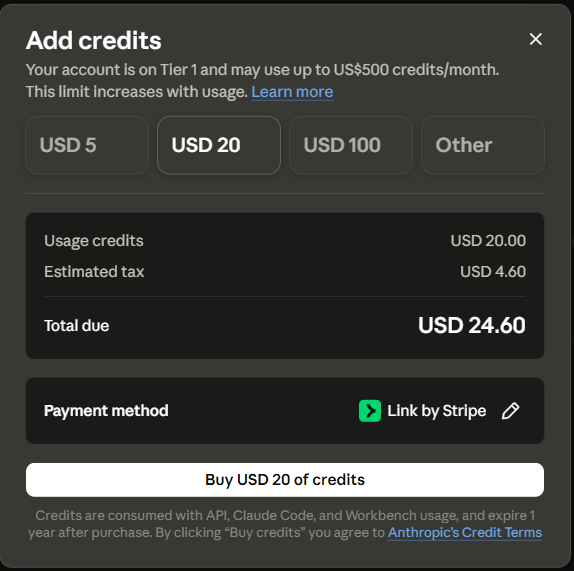
The top-up popup is explicit: USD 20 in usage credits, USD 4.60 in VAT, USD 24.60 total, and a bottom line stating that the credits expire one year after purchase.
At that moment, I was furious.
So here is this essay.
Not for the $24. For one fucking thing: fairness.
2. It was designed this way
This is my judgment. My personal judgment.
This is not an edge-case clause. It is not an oversight by the legal team. It is not a product manager's mistake.
It functions like a carefully designed structure of consumer asymmetry.
Real money enters. It is converted into internal points. A countdown timer is attached. When the countdown ends, the unused part stays on Anthropic's books, and the consumer's side is cleared to zero. Credits are non-refundable. They have no cash value. These are words Anthropic chose to write into its own terms.
The design feels familiar. It is the bottom-tier mobile-game token mechanic that early internet users already learned to hate: real money buys a string of time-limited virtual units, and the platform quietly hopes users forget, underuse them, or have unstable demand, so it can extract extra profit.
There are many low-frequency users in the API market: people testing a model, running a temporary project, trying Claude Code, or making occasional API calls. Once they top up, it is very easy for them to leave a balance unused for a long time. When a platform designs unused paid credits to expire after one year, dormant balance naturally becomes platform revenue.
This is a choice, an immoral choice, and it represents a company's values.
3. Does the negotiation table exist?
Someone will say: you agreed to the terms, so it is legal.
Really? Under whose law?
Law is not omnipotent. Law also has gray areas. But human society should still have other baselines: morality and common sense.
Especially when Anthropic, a company that presents itself around an AI constitution, and which is, as of June 11, 2026 in my social-media-level impression, the highest-valued Pre-IPO AI infrastructure company in the world, does something as nasty as a bottom-tier mobile game company. WTF?
This is the value system you keep talking about?
This is the constitutional morality your CEO keeps promoting every day?
As an individual consumer, I perhaps, obviously, have no leverage to sit at the same negotiation table with Anthropic.
That does not matter. Even a small individual consumer has the right to speak.
The terms are written by them. My options are only two: accept, or do not use the service. There is no third option.
But the essence of a one-sided term does not change.
Yes, Anthropic. Maybe you did not break the law. But you are definitely shameless.
Especially when you promote values in the media while running petty billing games behind the billing page.
This judgment can be recognized by any normal human eye, and judged by common sense.
4. Dollars go in. Legal abstraction makes them vanish.
There is another question Anthropic needs to answer directly.
When taking payment, Anthropic charged VAT from a Lisbon user through Stripe. That means this transaction was treated as a real service transaction at the collection stage, went through a full tax process, and carried an undeniable real-transaction character.
But when the balance expires, the platform emphasizes that credits are not money, have no cash value, are non-refundable, and are non-transferable.
Both things are true at the same time: when money is collected, the transaction is real enough to be taxed; when the balance expires, it becomes an internal point with no cash value. The platform has unilaterally taken the power to define the nature of the funds.
This is a public question that is hard to avoid:
If this transaction is real enough for Anthropic to charge VAT from a Lisbon user, why does it suddenly become an internal point with no cash value when the unused balance is unilaterally expired? Why is it a real transaction when tax is collected, and a token when it is cleared?
At this point, the EU should be tagged.
5. If AI is the future of human society
This is the part I really want to talk about.
This is not only a billing complaint. It is a small visible test of how future AI infrastructure companies may behave when users have no real bargaining power.
If AI services were just ordinary consumer products, the boundary of this incident would be simple: if you are unhappy, switch; if you cannot switch, accept it. That is market freedom.
But AI technology is clearly not that.
Look at one set of numbers first.
In May 2026, Gartner forecast that worldwide AI spending would reach about USD 2.59 trillion in 2026, up 47% year over year, and rise further to about USD 3.49 trillion in 2027.[1] This is already on the scale of the annual nominal GDP of large economies, close to the annual size of Canada, Brazil, Russia, or Italy; by 2027, the number will move closer to France's annual nominal GDP.[2] This is why, in the near term, companies connected to the AI infrastructure theme are being repriced by the market: chips, memory, cloud services, AI-optimized servers, IaaS (Infrastructure as a Service), network switching, data center power and cooling, and so on, are all entering a new high-growth cycle. The same Gartner report also projects AI infrastructure to be the largest spending category, at about USD 1.43 trillion in 2026 and about USD 1.89 trillion in 2027.[1]
The conclusion is obvious. Once a new technology enters capital expenditure, enterprise workflows, organizational budgets, job restructuring, and infrastructure construction, it is no longer just a hot topic in public discourse. It starts becoming part of real organizational systems.
More and more evidence shows that AI is becoming the foundational technological base for the next generation of human social organization. This is not a metaphor. This is reality and direction.
Workflows, knowledge production, decision support, code, content, and communication are being deeply restructured by AI. Over the next five to ten years, this penetration will only deepen. It will not reverse.
That means some of today's practices may become tomorrow's industry norms.
Grand narratives, petty billing. The two coexist almost too naturally inside one company.
A company that unilaterally sets a one-year expiration date on a user's real-money account balance is telling all of human society, through this choice:
Your money is my money. A user's prepayment is a lamb that can be legally slaughtered, as long as I unilaterally declare on the top-up interface: these are Credits. Perfect. Of course, VAT must still be collected first.
If this choice continues to scale, it will settle into an ecosystem: the foundational layer of AI services can systematically exploit asymmetrical power to extract extra profit, perhaps even to do whatever it wants.
6. Today it is only $24. What about tomorrow?
USD 24 and USD 3 trillion obviously cannot be compared.
For me personally, it is the same: USD 24 is not the point.
The point is this: when these future AI giants have greater power, deeper user dependence, and stronger bargaining positions, what will they do to everyone?
Today, they choose to design a system that lets credits quietly expire.
Today, they choose to make it a real transaction when VAT is collected, and an internal point with no cash value when the balance expires.
Then what about tomorrow?
The more you think about it, the more chilling it becomes.
The one-sided term on the billing page already represents their choice. That is already part of the answer.
I think saying this now matters to me. No, to us.
Postscript: I wronged you by $5.30
After finishing this essay, I was still uneasy.
People forget things, especially something like API credits. Did I use them a year ago? How much did I use? I did not want to misremember the old account and unfairly accuse Anthropic.
So I went back into Claude Console to check.
First, I confirmed the original purchase. The official Invoice and Receipt for June 4, 2025 are clear: the description is One-time credit purchase, the credit amount was USD 20, VAT was USD 4.60, the total was USD 24.60, and the invoice was paid.
Then I checked Cost.
Here comes the interesting part: Anthropic's Cost page cannot query a full year directly. A custom range can span at most 31 days. In other words, if I want to verify how much a one-year paid credit grant was used, how much remained, and how it expired, there is no one-glance credit ledger. I have to query month by month, download CSV files month by month, merge them myself, and deduplicate them myself.
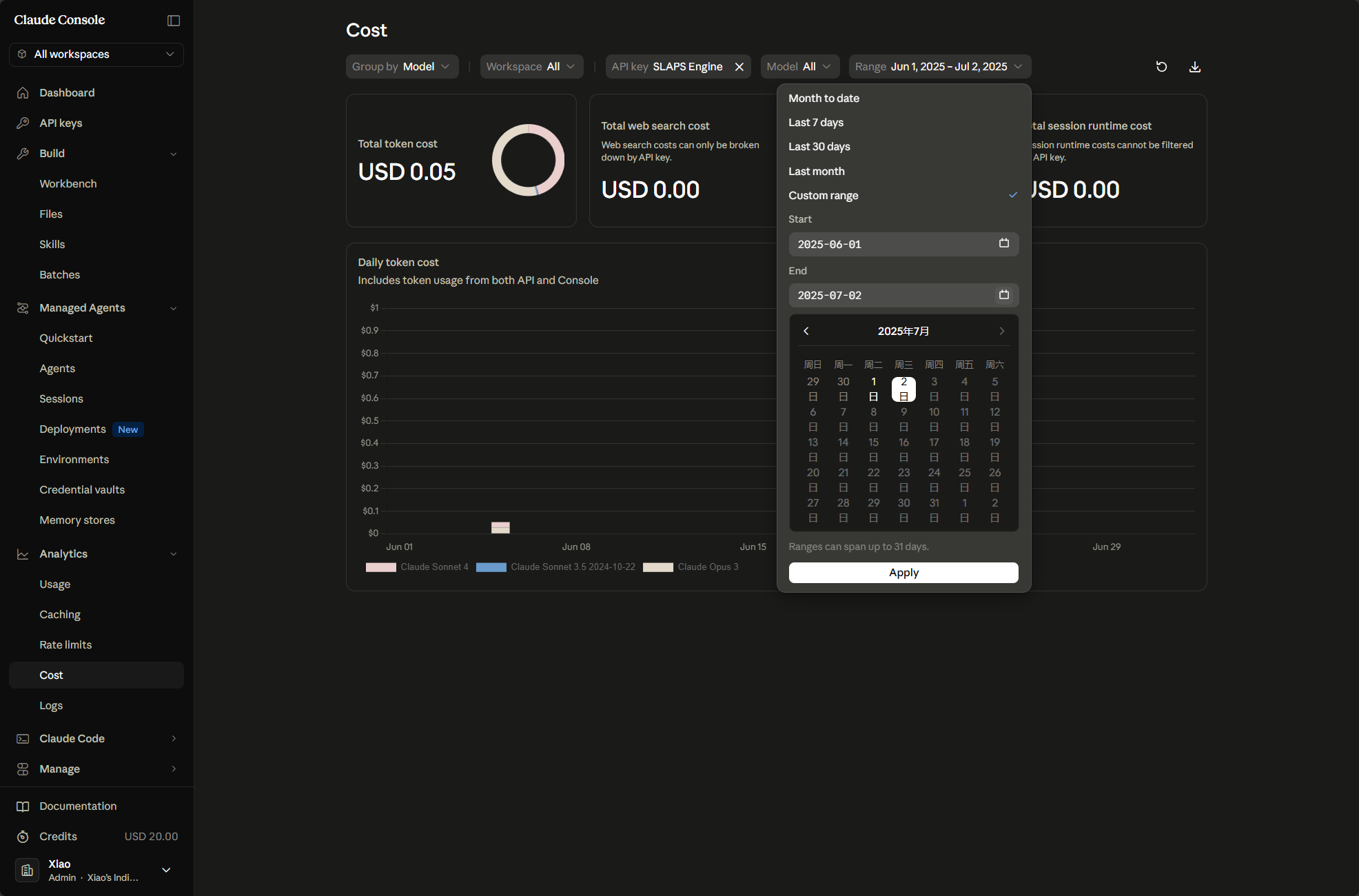
The Cost page limits the end date of a custom range to a 31-day span and directly shows Ranges can span up to 31 days. That means a user cannot audit a full year of credit usage and expiration in one view.
How considerate of you.
I downloaded the Cost records month by month from June 2025 to June 2026. After merging them, I found that the visible consumption during the year was not zero.
I did use it.
After deduplication, the total was USD 5.30.
So yes, Anthropic, I wronged you by $5.30.
But that changes none of the judgments above.
Because the question was never whether I clicked the API a few times. The question is this: I bought USD 20 of paid credits with real money and paid USD 24.60 in total; visible usage during the year was USD 5.30; the remaining about USD 14.70 of paid credits was marked Expired after one year, with no refund, no extension, and no cash value.
More ironically, to confirm this, I had to download the records month by month, stitch the ledger together myself, and deduplicate it myself. You make Expired immediately visible in Invoice history, but you do not let users see at a glance how much of a paid credit grant was used, how much remained, and how it expired.
This is not an ordinary expiration rule.
This is making expiration easy and reconciliation hard.
Petty, and ugly.
So I correct one fact: I did use some of it.
But I add one more charge: Anthropic, you did not just wipe out paid credits. Your behavior is ugly to the extreme. I despise it.
References
[1] Gartner: worldwide AI spending is forecast to reach about USD 2.59 trillion in 2026, up 47% year over year, and about USD 3.49 trillion in 2027; AI infrastructure is projected to be the largest spending category. https://www.gartner.com/en/newsroom/press-releases/2026-05-19-gartner-forecasts-worldwide-ai-spending-to-grow-47-percent-in-2026
[2] World Bank: GDP current US$, used to compare annual nominal GDP scale across economies. https://data.worldbank.org/indicator/NY.GDP.MKTP.CD
[3] Anthropic Credit Terms: terms concerning usage credits, non-refundable status, one-calendar-year expiration, and no cash value. https://www.anthropic.com/legal/credit-terms
[4] Claude Help Center: explanation that Claude API, Workbench, and Claude Code use prepaid credits, and that purchased credits expire one year after purchase. https://support.claude.com/en/articles/8977456-how-do-i-pay-for-my-claude-api-usage
About the Author
Wang Xiao is an AI protocol architect, author of System and Freedom, creator of Danbing AI Protocol / SLAPS Framework, and initiator of OathAI.
His work focuses on human-AI co-creation, protocol governance, semantic anchoring, and long-term knowledge continuity, exploring how human knowledge and collaborative structures can be preserved, calibrated, and inherited in the AI era.
Disclaimer
This essay reflects the author's current observations and methodological reflections based on personal practice, research, and human-AI collaboration experience. The related Danbing / SLAPS / OathAI methods are still being organized and evolved. Their practical effects may vary depending on the user's background, task context, model capability, execution environment, and level of commitment.
This essay does not constitute legal, investment, medical, career, or technical implementation advice or guarantee. Readers who apply these methods in real projects should make independent judgments based on their own circumstances and take responsibility for specific outcomes.